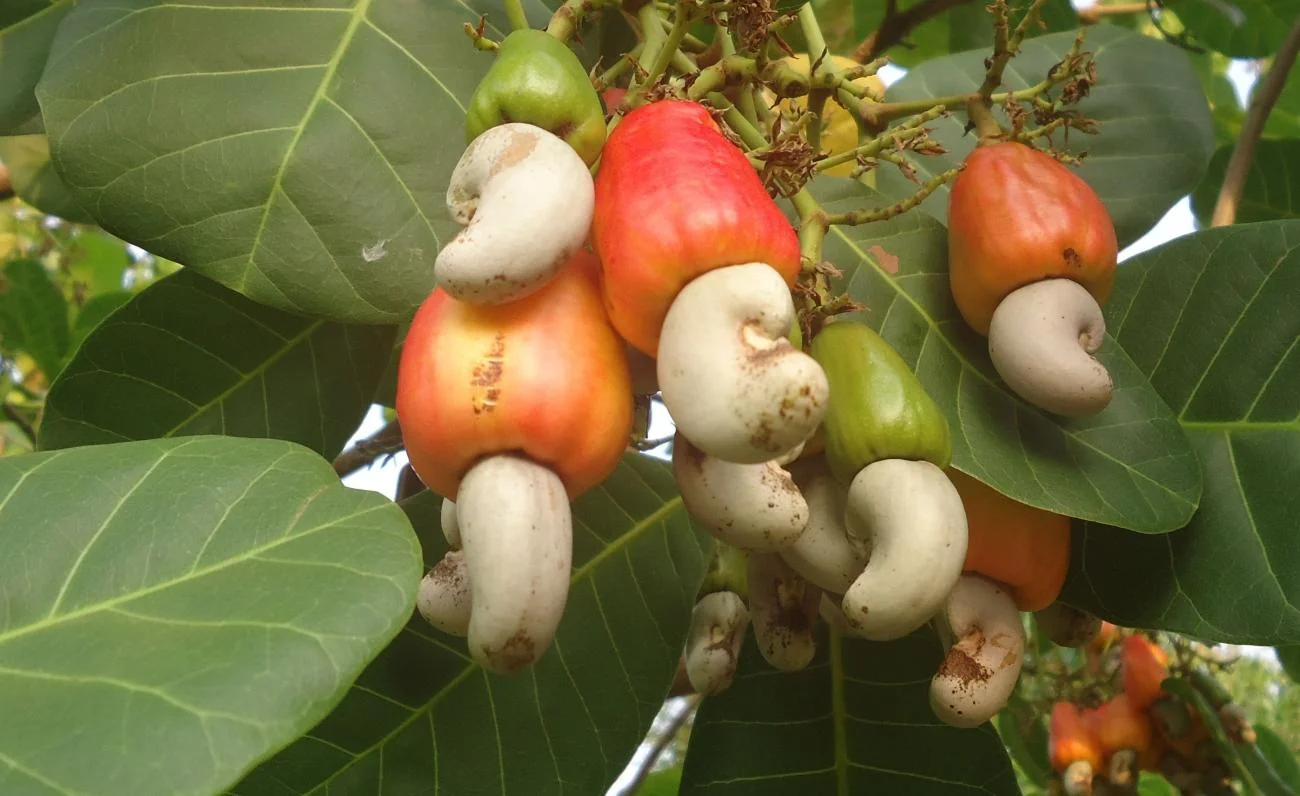
The cashew is one of the world's favourite nuts, and its name carries its history: the word comes from the Portuguese caju, tracing back to the tree's kidney-shaped fruit. The Portuguese first carried the cashew out of Brazil, and today it is grown across the tropics. Strictly speaking, the cashew is not a nut at all but a seed, hanging from the underside of the cashew apple. Cashews are a rich source of vitamin K, dietary fibre, omega-3 fatty acids, copper, manganese and magnesium.
Are raw cashews edible?
The cashew kernel itself is not toxic, but the shell around it contains urushiol, the same irritant found in poison ivy. Contact can cause itching, irritation and dermatitis, which is why cashews are always processed before sale, with the toxic layers removed carefully, typically by roasting. The "raw" cashews in shops have already been through this step.
Years ago the cashew was valued only as a snack nut. Today nearly every part of the crop finds a use. Here is a quick tour.
Cashew kernels
The kernel is the star product. Extracted from the shell and roasted, kernels are graded and sold as a nutritious food rich in vitamins, minerals, carbohydrates, healthy fats and protein.
Discarded cashew nuts
Kernels that do not make food grade are not wasted; they are kept for livestock feed.
Cashew apples
The bright cashew apple is too fragile to transport, so it is mostly used in the countries where it grows. It can be eaten fresh in salads, cooked into syrups and jams, or pressed for juice.
Cashew pulp (bagasse)
After the juice is pressed from the apple, the remaining pulp, technically called bagasse, makes excellent livestock feed.
Cashew nut testa
The testa is the thin red skin left on the kernel after shelling. Removed during processing, it too goes into animal feed.
Cashew tree leaves and timber
Young cashew leaves can be eaten fresh or cooked in some cuisines. The timber makes good firewood and a charcoal substitute, producing generous heat.
Cashew shell products
- Cashew oil: used industrially and medicinally, and in surface coatings, paints and wood treatments.
- Cashew biofuel: produced from pressed oil cakes in solid or liquid form, a powerful bio-oil.
- Cashew nutshell liquid (CNSL): extracted from the shell's mesocarp, composed of roughly 70% anacardic acid, 18% cardol and 5% cardanol. It goes into epoxy resins, varnishes and other high-performance materials.
Nutrition and precautions
Cashews are a valuable part of a health-conscious diet, rich in oleic, linoleic and palmitoleic fatty acids, and cashew apple juice is high in antioxidants and vitamin C. One caution applies: tree nut allergies to cashew can be severe, ranging from itching and nausea to anaphylaxis, which needs immediate medical attention. And as with any rich food, moderation is wise.
We import raw cashew nuts from trusted origins with genuine out-turn grades; see our import products for details.