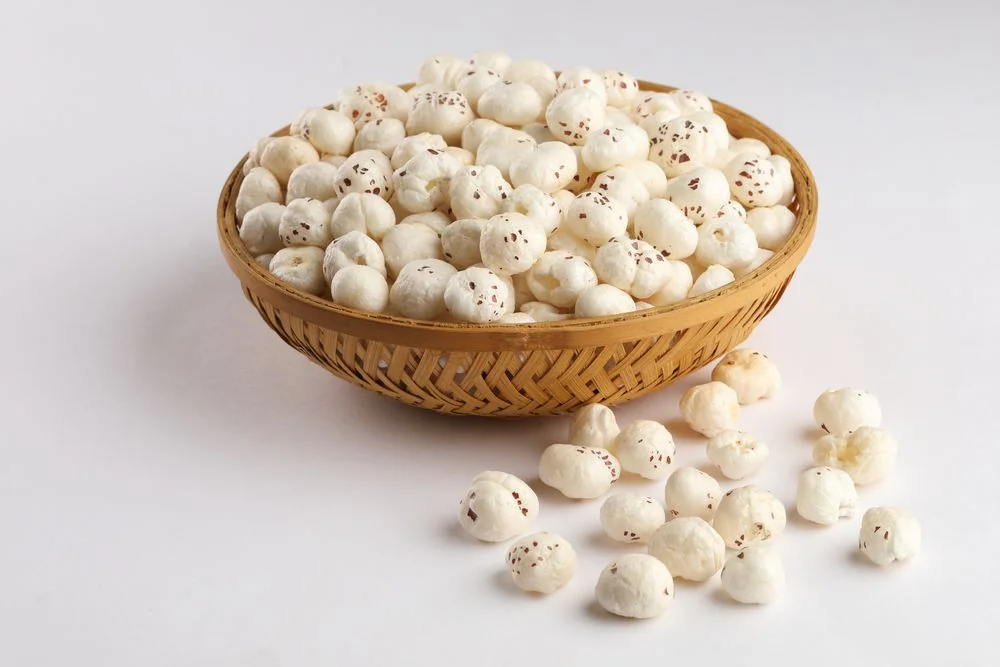
Makhana, also known as fox nuts, lotus seeds, gorgon nuts or phool makhana, is a favourite across Indian kitchens: in sweets, raita, makhana curry, and above all as a roasted evening snack alongside a cup of tea. It is also one of India's most promising niche exports.
Where is makhana grown?
Makhana is produced in several parts of India, including Bihar, Madhya Pradesh, Rajasthan, Tripura and Manipur. Bihar leads by a wide margin, accounting for more than 85 percent of India's total production.
What is driving demand
- Health-conscious consumers seeking wholesome snacks
- A good snacking option for diabetics and heart patients, with good fats and little saturated fat
- The rapid growth of the ready-to-eat snack category
- Rising demand for gluten-free protein foods
- Growing use in cosmetic products
Global prospects
Over the 2019 to 2021 period, makhana demand grew at a compound annual rate of roughly 7 percent, with the market expected to add around 72.5 million US dollars in size. Makhana is already popular in India, Japan, the US, Australia, Thailand and China, while the potential in the US and UK remains largely untapped, leaving room for new players. As a tastier, healthier substitute for popcorn, fox nuts are well placed for the snacking shelf.
The Indian market in numbers
- Around 15,000 hectares under cultivation, yielding about 1,20,000 MT of seed, which processes down to roughly 40,000 MT of makhana
- Production worth about Rs 250 crore at the farm gate, generating around Rs 550 crore at the trader level
- Major export destinations include the USA, UK, Australia, Bangladesh, Pakistan and Gulf nations such as the UAE, Qatar, Saudi Arabia, Kuwait and Oman
- Despite this, exports are only 1 to 2 percent of production, roughly 100 to 150 tonnes of popped makhana a year
Export figures for 2019 to 2021 tell the same story: total export value of about 1.39 million US dollars on 292,822 kg shipped, at an average price of 4.74 dollars per unit. The top buyers were the United States (751,132 dollars), the United Kingdom (171,480 dollars) and Canada (120,861 dollars), with Mundra, Nhava Sheva and Sabarmati ICD the leading ports of discharge. Branded players entering the category with flavoured makhana snacks have only accelerated consumer awareness.
Strategies to grow makhana exports
- Expand the growing area: makhana is an aquatic crop needing ponds and low-lying fields with standing water; the Bihar government extends a cultivation subsidy of roughly Rs 13,400 to 16,000 per hectare.
- Adopt high-yielding varieties: quality seed and farmer training on scientific cultivation practices are the fastest route to better productivity.
- Mechanise harvesting and processing: most makhana is still harvested and popped by hand, which limits hygiene and scale; low-cost machinery would change the economics.
- A separate HS code: makhana currently ships under HS code 19041090 alongside other products; a dedicated code and quality specification would make exports easier to track and promote.
- Branding and value addition: flavoured, attractively packed makhana sold through modern retail and e-commerce commands far better margins than loose produce.
Conclusion
There is huge scope for popped makhana and its value-added products in the international market, driven by the shift to healthy, natural snacking. Promoting consumption and exports, and organising farmers into producer companies, would earn valuable foreign exchange while lifting the incomes of the farmers who grow this remarkable crop.